

Between Transparency and the Art of Obscuring Facts
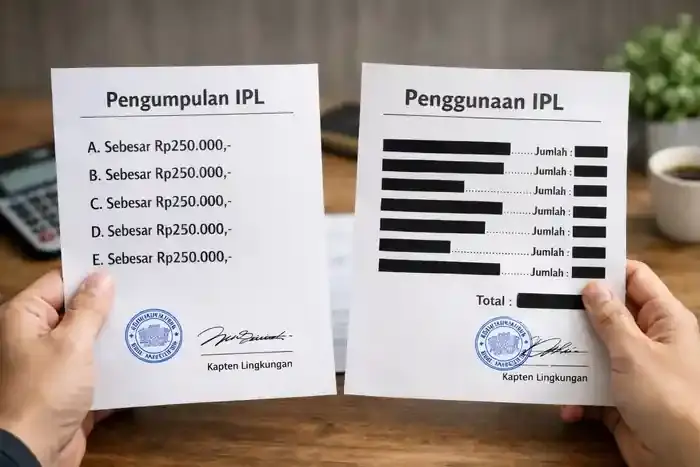
In residential community management, whether at the neighborhood association (RT/RW) or community service (P3SRS) level, the expense report is neither narrative nor poetry.
It does not thrive on metaphor, does not breathe through vague terms, and should not ask its readers to "presume the best." An expense report is a rational document, created precisely because humans are not secure enough to rely solely on good intentions. Although it is extremely rare, if not almost non-existent, at the P3SRS level these days, it is still important for residents to understand the magic tricks of this expense report, so that residents and owners are vigilant and understand the context of the expense report.
The function of an expense report is simple, yet uncompromisingly firm:
It presents figures in detail, measurably, consistently, and verifiably.
So when an expense report begins to be filled with phrases like:
"1 box/bag/package - Rp1,000,000"
what is happening is not accounting, but the art of obscuring the facts under administrative guise.
Also read other articles:
"Box/Bag/Package" Is Not a Unit of Accounting
In accounting, a box/bag/package doesn't define anything.
It's not a unit of measurement, not a cost classification, and not a basis for testing reasonableness.
The single line "1 box/bag/package - Rp1,000,000" raises a fundamental question that is deliberately avoided:
- What's in the box/bag/package?
- How many items does it contain?
- How much does it cost per item?
- Who was it purchased from?
- Is the price reasonable compared to market prices?
- Is the item actually needed or just "happened to be available"?
Without this answer, the figure of one million rupiah is just a bare number:
meaningless, untestable, and untraceable.
And an expense report without traceability is a sham report.
The Meaning of “A Group of People” and Intentionally Obscure Language
The same practice occurs when writing reports:
- “Paid to a group of people”
- “Honorarium for the committee”
- “Cost of arriving impromptu participants”
- “Other compensation expenses”
Accounting doesn't recognize the concept of groups.
All it recognizes is:
- Number of individuals
- Identity or category of recipient
- Amount per person
- Basis of payment
- Mathematically consistent total
If ten people are paid, it should be clear:
Who those ten people are, how much they received, for what work, and for what duration.
When these details are omitted, the expense report becomes a different function:
it is no longer a tool for transparency, but rather a trick and a smokescreen legalized by the tabular format.
Why Was This Report Deliberately Vague? Here's Why
Expense reports are never obscured without a reason. Some of the most common reasons include:
1. Intentional Obscuration of Facts
Detail is the enemy of irregularities.
The more detailed the figures, the easier it is for the public to spot irregularities, markups, or conflicts of interest. Therefore, details are omitted to make everything appear "normal."
2. Technical Inability to Prepare Reports
Not all managers understand basic accounting.
Instead of learning, they choose shortcuts: lumping expenses together to appear neat, even if logically flawed.
3. Reports Prepared Out of Compulsion
Not out of a sense of transparency, but because:
- Residents requested it.
- Regulatory requirements.
- Just an annual formality.
In this situation, reports are prepared for the sake of existence, not for verification.
4. Covering Up Administrative Irregularities
Scattered transaction evidence, weak documentation, or non-standard payments.
The solution isn't to fix things, but to obscure the numbers to avoid explaining the underlying chaos.
5. Avoiding Personal Accountability
Details open up questions: who made the decisions, who benefited, and who is responsible.
Vague reports break the chain, leaving errors unaddressed.
Real Losses for Those Who Trust It
For those who believe reports like this, fund owners, citizens, members or contributors will suffer real losses:
- Loss of ability to assess the reasonableness of costs
Without details, there's no comparison, no alarm. - Normalization of small waste accumulating into large ones
One "box/bag/package" today, ten "boxes/bags/packages" next month, and suddenly the budget leaks without a trace, especially since citizens' expenses are routinely transferred to individual income. - Difficulty detecting conflicts of interest
Without identities and details, the personal relationships behind transactions become invisible. - Dependence on blind trust
In fact, the expenditure reporting system was created precisely to reduce reliance on individual morality. - Weakening the public's critical stance
When reports cannot be verified, criticism is easily dismissed with one classic phrase:
"This is in accordance with internal regulations," "This is in accordance with the instructions of the elders," "This is in accordance with social sincerity," and other excuses.
Accounting Is Not About Good Intentions
It needs to be emphasized repeatedly:
Valid expense reports can always be read, tested, and re-traceable.
If an expense cannot be explained in detail, then the problem is not an overly critical reader, but rather a recorder who failed or deliberately avoided transparency.
Accounting did not arise because humans were evil,
but because humans should not be allowed to work without rational oversight.
At this point, unclear expense reports are not simply a technical error,
but a matter of management ethics.
FAQ
1. Are expenditure reports required to be that detailed?
Yes. Without detail, the report loses its primary function: accountability and verification.
2. Is lumping items together always wrong?
Not always, as long as they can be explained when requested. If they can't be explained, that's a red flag and an indication of irregularities.
3. Does a vague report automatically mean corruption?
Not automatically, but it always opens up room for irregularities and self-justification. Citizens are also required to check whether the person managing the expenditure report has a permanent job.
4. What are the characteristics of a healthy expenditure report?
Detailed, consistent, traceable, and not resistant to questions.
5. What are the first steps if you encounter a report like this?
Ask for written details.
If they can't provide them, the problem is clearly not the numbers, but the integrity of the process. If it's routine and repeated over years, it's better for citizens to report their complaints to the authorities.
Read other articles too:
- The Mystery of Invisible Power in Community Management
- The Phenomenon of Utilizing Shared Public Spaces
- Project Transparency in the Community
- The Role of Buzzers in the Community