
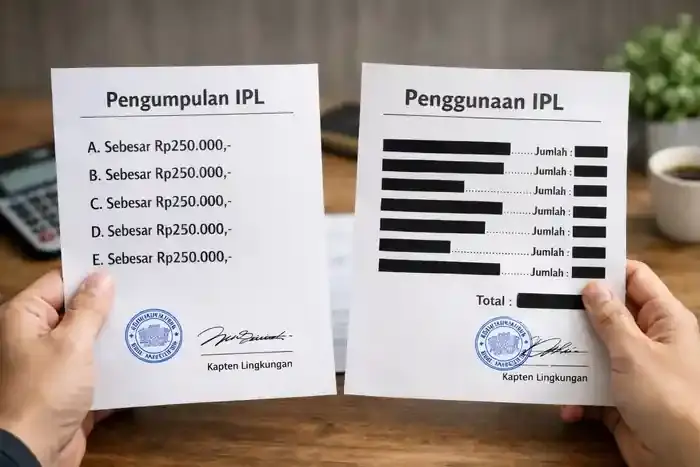
The Imbalance Between Payment Obligations vs. Ignored Reporting Rights
The issue of IPL in P3SRS or even at the RT/RW level does not begin with bad intentions. It originates from a collective intention: to keep the environment safe, clean, and livable. In its ideal concept, environmental management fees are a form of modern mutual cooperation—residents contribute, managers work, and everyone enjoys the results.
However, like many other social systems, the damage does not come from the concept, but from its practice.
In reality, what often occurs is a recurring anomaly: residents are required to pay diligently, yet their right to know how the funds are used becomes unclear. There are no monthly reports. No breakdown of expenditures. No clear accountability forums. In many cases, there is not even the slightest initiative from management to voluntarily disclose the data.
This is not merely an administrative shortcoming. It is a structural failure.
The relationship between residents and management shifts silently. Residents are positioned as parties obligated to comply, while management occupies an untouchable position. There is no healthy control mechanism. No balance between obligations and rights.
Whereas the most basic principle in a simple collective system is: Simply put, those who pay have the right to know.
When this principle is systematically violated, what is damaged is not only financial reporting. What is damaged is trust. And once trust collapses, its social cost is far greater than mere numbers in a report.
Even more dangerously, this condition creates normalization. Residents begin to get used to not knowing. Not asking. Not demanding. A passive culture forms—and this is fertile ground for greater deviations.
Read other articles as well:
Real Losses for Residents (With Numerical Illustration)
Let us bring this discussion down to concrete numbers. Because often, indifference arises when the amount feels insignificant—yet its accumulation is substantial.
Take a simple example:
A cluster or apartment with 500 active residents.
The IPL fee is set at Rp250,000 per person per month.
Total income:
500 × Rp250,000 = Rp125,000,000 per month
In one year:
Rp125,000,000 × 12 = Rp1,500,000,000 (1.5 billion rupiah)
This is not a small figure. It is equivalent to the operational budget of a small company.
Now the question is:
Has the use of this amount ever been explained in detail to residents?
Logically, routine expenditures usually include:
- Security staff salaries (e.g., 8–12 people): Rp25–35 million
- Cleaning staff: Rp10–15 million
- Public facility electricity: Rp10–20 million
- Garden and light infrastructure maintenance: Rp5–15 million
- Administrative and other operational costs: Rp5–10 million
Rough total: around Rp60–95 million per month.
This means, mathematically, there is still a potential gap of Rp30–60 million each month. In a year, this gap can reach Rp360–720 million.
Without transparent reporting, this figure has no identity. It cannot be verified, tested, or held accountable.
This is where residents' losses become real.
First, direct financial loss.
Residents pay more than they should, or at least do not know whether what they pay is efficient or not. Without transparency, there is no way to evaluate whether costs are too high, reasonable, or wasteful.
Second, loss of service quality.
Ironically, many environments with high IPL fees have mediocre facilities. Damaged roads are not promptly repaired. Security is lax. Cleanliness is inconsistent. This raises a fundamental question: where is the money actually allocated?
Third, social loss.
When there is no transparency, residents begin to speculate. Speculation breeds suspicion. Suspicion breeds conflict. A community that should be harmonious turns into one full of prejudice.
Fourth, collective psychological loss.
Residents become apathetic. They choose silence because they feel powerless. Phrases like “it’s normal” or “no need to make it an issue” begin to appear. This is not maturity. This is social fatigue.
And most dangerously:
When a non-transparent system is allowed to persist, it will evolve. From being unclear, to becoming dishonest. From dishonest, to becoming exploitative.
Religious Perspective: Trust Without Transparency is a Contradiction
From a religious perspective, especially in Islamic values, the management of collective funds cannot be separated from the concept of trust (amanah).
Amanah is often misunderstood as merely “trust given.” In a deeper sense, it includes three things:
- Accepting responsibility
- Executing it properly
- Accounting for it openly
The problem with non-transparent IPL usually stops at the first point. Managers accept the trust. They carry out activities. But stop before the accountability stage.
This is where the contradiction occurs.
Managing funds without reporting is not merely untidy. It touches the moral domain. Because in religious ethics:
- Concealing information that is the right of others → a form of dishonesty
- Avoiding reporting → avoiding accountability
- Allowing ambiguity → opening the door to doubt (syubhat)
Even if there is no bad intention, lack of transparency remains problematic. Because religion assesses not only intention, but also process and impact.
A simple relevant question:
If this management is correct and clean, why not present it openly?
In many teachings, including Islam, transparency actually protects managers. It is not a threat. It is proof that the trust is carried out properly.
Conversely, secrecy is a burden. It creates room for slander, suspicion, and social harm that could have been avoided.
Legal Perspective: From Negligence to Potential Violation
Legally, IPL funds fall into the category of collective funds. This means they are not owned by individuals or management groups. They belong collectively, with management delegated.
The consequences are clear:
- Management acts as administrators, not owners
- There is an obligation to report
- There is an obligation of accountability
- Residents have the right to access information
When reports are never made or never delivered, it is no longer just a technical shortcoming. It enters the realm of negligence that can potentially become a violation.
In the Indonesian legal context, transparency and accountability are not optional in managing collective funds. If there are indications of:
- Use of funds not aligned with purpose
- Lack of clear records
- Refusal to provide reports
This can develop into allegations of abuse of authority, and in certain cases may lead to embezzlement.
What often occurs is a gray area. No reports, but also no audits. No proof of violations, but also no proof of compliance.
This zone appears safe, but is fragile. Because once conflict arises, there is no data to serve as a basis for defense.
Interestingly, transparency not only protects residents. It also protects management. With clear reports, all parties have a reference. There is no room for slander. No room for wild speculation.
Conclusion
The IPL issue is not about numbers. It is about power structure on a small scale.
When residents keep paying without ever knowing, and management keeps managing without ever explaining, what forms is not a community—but a one-way system prone to abuse.
The solution is not complicated, but often avoided:
transparency, routine reporting, and open access to information.
Because ultimately, trust is not built from the obligation to pay.
But from the courage to be accountable.
The core problem lies not in residents' criticism, but in a system accustomed to not being monitored. As long as there is no push for change, secrecy will continue to be considered normal. Therefore, transparency must be positioned not as an option, but as a non-negotiable obligation.
FAQ
1. Why do managers never provide IPL reports? Is it merely negligence?
If it happens once or twice, it may be called negligence. But if it continues consistently, it is no longer negligence—it is a deliberate pattern. Funds are collected regularly, yet reports are never delivered. This shows one-sided comfort in managing without the obligation to explain. The solution is clear: management must realize that reporting is not a request from residents, but an inherent obligation in managing collective funds.
2. Is the absence of reports really a serious issue?
Very serious. Managing large sums without reporting is not an administrative issue, but an accountability issue. In other contexts, such as companies or formal organizations, this condition is enough to trigger audits or even investigations. There is no reason residential environments should normalize opacity. The solution: residents must request concrete reports, based on figures and evidence—not vague explanations that cannot be verified.
3. What is the ethical and religious perspective on this condition?
Ethically, trust without openness is a form of neglecting responsibility. In religion, amanah must not only be carried out but also accounted for transparently. When managers refuse to disclose reports, what is questioned is no longer residents’ perception, but the integrity of the managers themselves. The solution is simple: full transparency, not blind trust.
4. What should residents do if report requests are ignored?
Silence is not a wise option. Requests must be submitted in writing and openly, so they are recorded and cannot be easily ignored. If there is no response, residents need to build collective strength and push for discussion in a shared forum. If still ignored, make it go viral on social media. The goal is not to create conflict, but to force accountability that has long been avoided.
5. Is publishing this issue on social media an excessive step?
No, as long as it is done responsibly. What is excessive is long-term fund management without transparency. Public exposure becomes relevant when all reasonable communication channels are ignored or dismissed. However, what must be presented are data, chronology, and facts—not baseless opinions. In many cases, social pressure through transparency is the most effective way to drive change.
Read other articles as well:
- The Unseen Emerges When Residents’ Voices Are Silenced
- Between Glue Intoxication and Residential Hallucinations
- Project Transparency in Communities
- The Role of Buzzers in Communities
- The Magic Tricks of Expense Reports in Communities