
How to Protect Your Money from Hidden Costs
Fuel price increases are never as simple as the numbers displayed at gas stations. They do not stop there. They affect every aspect of your life. The problem is not the increase itself. The problem is how we respond to it.
Some people panic. Others become too relaxed, thinking that a small increase will not have a significant impact. In reality, crises never come with an explosion. They come through accumulation—quietly, consistently, and often disguised as small things that seem insignificant.
This is where life in residential environments—whether housing complexes, apartments, or social structures such as RT, RW, and P3SRS—begins to reveal its true nature. Some operate properly. But many exploit the gaps.
From Fuel Prices to Living Costs: An Unbroken Chain
When fuel prices rise, transportation costs automatically increase. This then drives up the cost of goods distribution, which ultimately raises the prices of basic necessities. In theory, this is a simple chain. In practice, the impact is far broader.
In residential environments, this increase is often used as a justification to adjust various fees. Maintenance fees rise under the pretext of operational costs. Social activities become more frequent in the name of solidarity. Donation proposals begin circulating with humanitarian narratives.
Everything seems reasonable. Even noble.
But precisely because it appears noble, many people stop thinking critically. They assume all requests are legitimate. They do not question. They do not verify. They simply pay.
And that is where the problem begins to grow.
Read more articles as well:
Residential Communities: Between Shared Interests and Gray Areas
Structures such as P3SRS, RT, and RW are indeed formed to manage collective living. Without them, coordination would be chaotic. However, in times of economic pressure, these structures can turn into gray areas—not because the system is flawed, but because the people within it have interests.
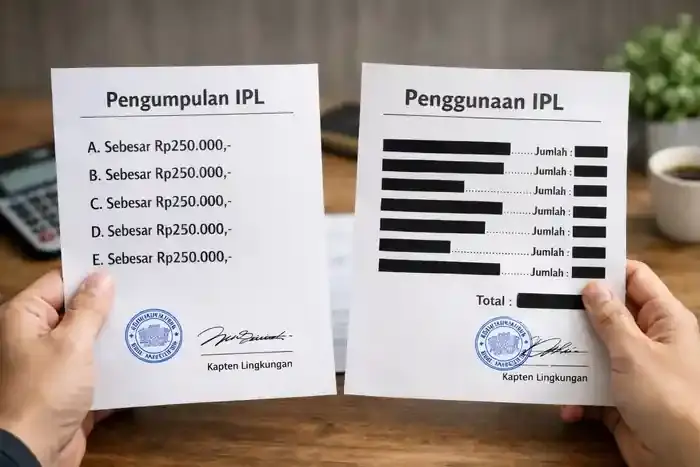
When operational costs are not explained in detail, when financial reports are not delivered regularly, and when decisions are made without transparency, the space for irregularities begins to open.
The issue is not always major corruption. More often, it starts with small things that are repeatedly ignored.
And one of the most subtle forms of this deviation is non-transparent donation practices.
Donation Hunters: Business Behind Compassion
In every crisis, there are always parties who adapt. Some seek solutions. Others see opportunities.
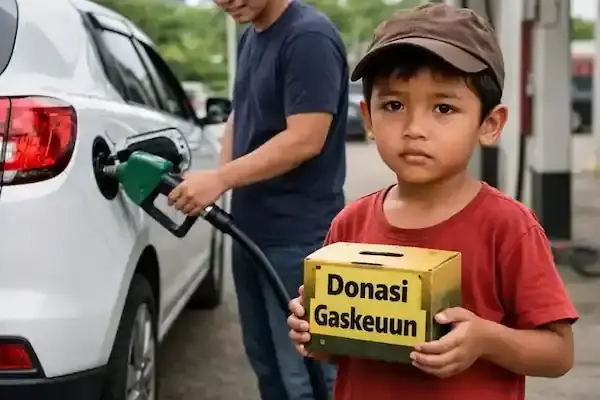
The phenomenon of “donation hunters” is a clear example of how empathy can be turned into a source of income. They understand one fundamental thing about humans: compassion often moves faster than logic.
With this understanding, they begin constructing narratives. Stories about poverty, hardship, or emergencies are crafted to evoke emotion. Not always lies, but often exaggerated. Sometimes selectively chosen. Sometimes wrapped in dramatization.
Then the narrative is given legitimacy. It is placed on letterhead. Organization names are attached. Not infrequently, they even use P3SRS, RT, and RW names.
However, upon closer inspection, the same pattern often emerges. There are no reports on fund usage. No documentation of beneficiaries. No audits. In fact, the accounts used are often personal accounts—under an individual's name, whether husband or wife.
This is where the line between social activity and manipulation begins to blur.
Because when donations are collected from hundreds of residents, in small amounts per person, the total can become very large. And without transparency, no one truly knows where the money goes.
The Illusion of Small Expenses That Drain Your Finances
One of the biggest traps in financial management is underestimating small amounts. Twenty thousand rupiah feels insignificant. Fifty thousand is still tolerable. One hundred thousand seems reasonable.
But when it happens repeatedly, in various forms—donations, additional fees, social contributions—the total begins to transform. It is no longer small.
Within a month, the accumulation of these expenses can reach a significant number. Ironically, many people do not realize it because they never truly record or evaluate their spending.
On the other hand, for fund collectors, this pattern becomes an effective model. Taking a little from many people is far easier than asking for a large amount from one person. The risk of rejection is lower, and resistance is almost nonexistent. This is not coincidence. It is strategy.
Letterheads and the Illusion of Legitimacy
One technique often used to build trust is the use of official-looking letterheads. Organization names are listed, logos are displayed, sometimes even combined with the names of associations or communities.
However, behind this appearance, there are often glaring inconsistencies. Two organizations are listed, but authorization comes from only one party. Or worse, there is no authorization at all.
For some, this may look like an administrative error. But in many cases, it is a form of perception manipulation. The goal is simple: to prevent residents from asking questions.
Legally, we must remember that only official administrative structures are valid and recognized by the state, not other organizations such as “The Singing Elders Council”, “Betta Fish Enthusiasts Community”and others. Therefore, combining both types of organizations into one letterhead is incorrect.
And as long as residents do not question it, the system will continue to operate.
Shifting Mindset: From Romantic to Rational
In unstable economic conditions, mindset becomes a determining factor. Many people feel that refusing donations is unempathetic. They worry about being seen as uncaring. They fear being judged negatively by their community.
But it must be understood that empathy without logic is a gap that is very easy to exploit.
Being rational does not mean being indifferent. On the contrary, it ensures that your concern truly reaches the right place.
In the context of rising fuel prices, priorities must be clear. Family financial stability is the foundation. Without it, you not only risk hardship but also lose the ability to help others sustainably.
Survival Strategies: Protecting Your Money Amid Economic Pressure
Facing rising fuel prices is not enough with good intentions. It requires concrete strategies and disciplined execution.
First, it is important to start looking at your finances honestly. Many people feel they are doing fine, when in reality, they never truly understand where their money goes. Tracking expenses for a full month will reveal many things that were previously unseen.
Second, the ability to distinguish between needs and wants becomes increasingly crucial. In normal situations, small mistakes may still be tolerable. But under economic pressure, the same mistakes can have greater consequences.
Third, expenses that have no clear value—including non-transparent donations—need to be reevaluated. This is not about being stingy or indifferent, but about being responsible for your own finances.
Fourth, vehicle usage patterns need to be adjusted. Reducing unnecessary trips, combining multiple errands into one, or finding alternative transportation are small steps that can have a real impact.
Fifth, a consumptive lifestyle must be controlled. Many expenses occur not out of necessity, but habit. And habits can be changed with awareness.
Sixth, often overlooked is the importance of an emergency fund. In situations where prices can change at any time, having financial reserves is no longer an option, but a necessity.
Conclusion: Protect Your Money, Protect Your Future
Rising fuel prices are an unavoidable reality. Beyond your control. But their impact does not have to destroy your finances.
What needs to change is not the situation, but how you respond to it.
Discipline in managing expenses, the courage to question transparency, and the ability to restrain unnecessary spending are three factors that will determine whether you survive or become trapped in economic pressure.
In times of crisis, small amounts of money are no longer trivial. They are part of a larger system. And if not guarded, they will continue to flow out without you realizing it.
Save your money. Protect your priorities. And do not let compassion be exploited by irresponsible systems.
FAQ
1. Should I completely stop donating during a fuel price crisis?
No. Donations can still be made, but they must be selective. Ensure there is transparency, clear reporting, verified beneficiaries, and that the collector is an organization.
2. How can I tell if a donation is transparent?
Check whether there are numerical reports on fund usage, activity documentation, and clear accountability. If these are absent, it is best to be cautious.
3. Will refusing donations in the community have social consequences?
Usually yes, because such groups often involve buzzers within the community, but it is typically temporary. With good and consistent communication, the community will understand your position. Moreover, Indonesia is a democratic country, not a monarchy.
4. How significant is the impact of small expenses on finances?
Very significant if repeated. Over time, the accumulation of small expenses can become a substantial burden without you realizing it.
5. What is the most effective first step to save money when fuel prices rise?
Start by recording all expenses. From there, you can identify patterns and determine which areas need to be reduced.
Read more articles:
- The Mystery of Invisible Power in Community Management
- Project Transparency in Communities
- The Role of Buzzers in Communities
- The Magic Tricks Behind Community Expense Reports