These Are Fatal Mistakes in Housing Financial Management
In managing financial budgets in residential neighborhoods, including neighborhood associations (RT/RW) and apartment community associations (P3SRS), there are often sudden proposals for increased spending.
To make this easier to understand, let's take an example. A proposed salary increase for security guards in residential neighborhoods, whether apartments, neighborhood associations (RT/RW), or community associations (RW), is fundamentally positive and humane, especially since in many cases these workers are still earning around the minimum wage (UMR). It's undeniable that the welfare of security guards is a vital part of shared comfort and security. However, one major mistake often occurs: decisions are made without proper financial analysis.
Instead of starting with the data, many administrators immediately jump to solutions. However, sound accounting and financial governance principles dictate that decisions should always be based on the actual financial situation.
Read other articles:
Let's take a moment to reflect on proper, comprehensive, and systematic financial management procedures. We'll also consider why raising salaries without an audit is a very risky move, and what should be done before making a decision.
The systematic steps before making a decision are as follows:
1. Income Must Be Clear: How Much IPL Is Actually Coming In?
The first step is to determine the total income from IPL (Environmental Management Fees). Knowing the target figure is not enough; it must also be clear how much is actually coming in.
Are there any residents in arrears, for whatever reason?
What is the payment compliance rate? Without this data, we don't know whether the finances are healthy or whether there are actually leaks on the income side.
2. Expenditure Audit: Is There Waste?
After income, the next step is to examine expenses. All expenses must be detailed and analyzed.
Are there any non-essential expenses? For example, group meals, group outings, ceremonial events, or other costs that don't directly impact primary needs.
Often, the problem isn't a lack of money, but inefficient use of money.
3. Cost Structure: Largest Expenditure Items Must Be Reasonable
It's important to know where the largest expenses are. Is it security, cleaning, electricity, communal meals, gatherings and singing together, or other activities?
If comparisons between financial items are not made, a budget imbalance can occur.
4. Financial Position: Surplus or Deficit?
This is the crux of it all. After income and expenses are calculated, and the balance should be clear, determine whether the finances are in surplus or deficit.
If there is a deficit, then increasing the IPL burden is a logical decision.
If there is a surplus, then there is room to consider a salary increase.
5. Salary Benchmark: Compare to Real Standards
Salary increases should be based on comparisons with existing standards, such as the local minimum wage or security salaries at other residences.
The goal is to ensure that wage decisions are neither too low (inhumane) nor too high (excessive).
6. Budget Priorities: Differentiate Between Needs and Wants
Security is a primary need (core), while activities such as meetings, lavish snacks, or excessive consumption are secondary needs.
If the budget is spent on secondary items while primary needs are suppressed, misprioritization occurs.
7. Transparency and Accountability
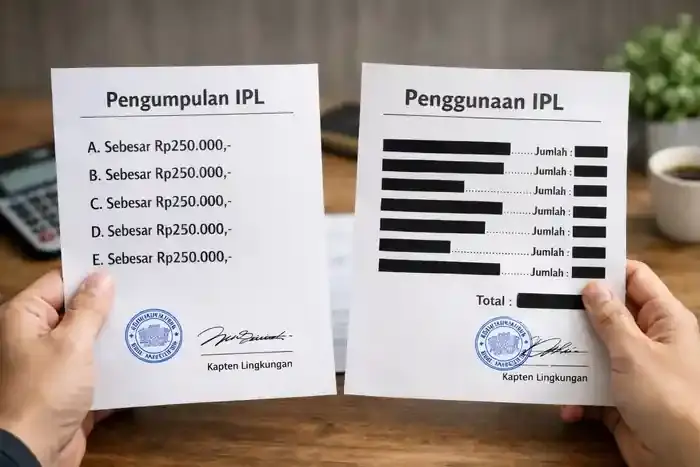
Without transparency, all decisions will raise suspicion. Financial reports must be open, regular, in the form of numbers (not narratives or images), and accessible to 100% of residents. Without transparency, there is the potential to create much bigger financial problems and leaks.
8. Financial Simulation and 100% Resident Involvement
If salaries are increased, should the IPL also increase?
Scenario:
a. If yes (the IPL increases), can residents afford it?
If it is not calculated, the worst-case scenario is increased arrears because residents feel burdened.
It is also necessary to examine the social dynamics of residents' finances: are residents' finances being eroded by other donations that are not visible on the surface, thus objecting to the IPL increase?
b. If not (the IPL remains the same), efficiency measures need to be implemented on the IPL side.
9. Collection System: Leaks Must Be Plugged First
It is pointless to increase the budget if the collection system remains weak. Some still cite non-payment of IPL, as well as other secondary and tertiary needs that routinely drain funds. A clear mechanism must be in place to ensure all residents pay their dues, as well as to curb financial leakage, such as unclear illegal donations that are not for the residents' own benefit.
Conclusion: This Isn't Just a Miscalculation, But a Mistake in Thinking
This problem isn't just an accounting or logical error. It's a failure of governance.
Decisions are made without data, without transparency, and without analysis. This opens up the risk of conflict, deficits, and a loss of public trust. Good intentions are no substitute for financial reporting. Without data, all decisions are assumptions.
A salary increase is a final decision, not a starting point. Without an audit, it's not policy, but speculation and gambling in financial governance.
If left unchecked:
• Hidden deficit
• IPL increases without clarity
• Citizen distrust
• Internal conflict
• Potential for abuse
Everything will happen slowly, over years and there will be justification, because an audit has never been carried out.
FAQ
1. Is it wrong to want to increase security guards' salaries?
No, it's actually very good. However, it must start with and be based on a clear financial situation first, as well as a thorough financial analysis.
2. What is the first step before discussing a salary increase?
Examine income and expenses in detail. Not through narratives and pictures, but through NUMBERS.
3. Why is transparency important?
Because without transparency and reporting, decisions will breed suspicion and conflict, and will simply be financial waste.
4. Should the IPL always increase if salaries increase?
Not always, it depends on the financial situation. If there are efficiencies, increases can be covered without increasing the IPL. Another solution is to increase the budget by consensus.
5. What are the biggest risks if decisions are made without data?
Financial deficits, community conflict, and loss of trust in management. Income and expenditure leaks remain a mystery.
Read other articles:
- The Mystery of Invisible Power in Community Management
- Project Transparency in the Community
- The Role of Buzzers in the Community
- Magic Tricks for Expense Reports in the Community