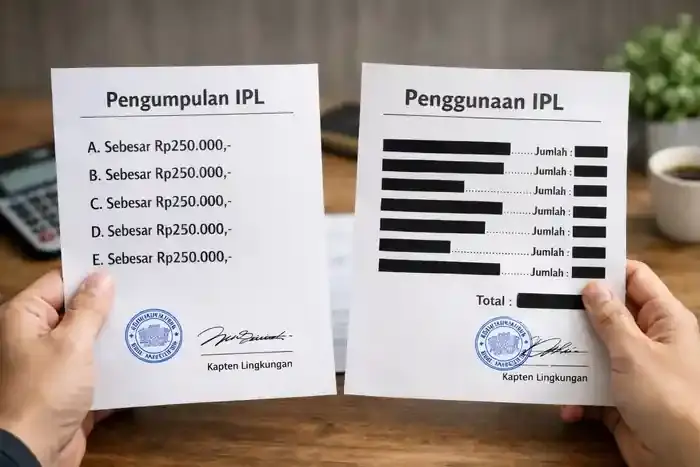


Transparency or Indication of Covert Manipulation?
When the Report Exists, But Cannot Be Read
In many apartments, PPPSRS financial reports do exist. They're displayed, shared during RUTA (housekeeping meeting), or sent via group chat. But the problem isn't their existence, but their readability. When reports are filled with unfamiliar terms—even entirely in English—most owners and residents don't truly understand their content.
This is where a serious question arises:
Is this simply a professional gesture, or is it a subtle ploy to dissuade members from being critical?
This isn't necessarily fraud, but it could be an indication of transparency manipulation—transparent on the surface, opaque on the inside.
Unintelligible Language = Failed Transparency
Transparency isn't about "the documents are there." Transparency means:
- Readable by members
- Understandable without having to be an accountant
- Can be questioned in a healthy manner
If the report uses terms such as:
- Revenue
- Accrued Expense
- Deferred Income
- Provision
- Equity Adjustment
Without a lay explanation, for many owners:
The report is no different from a secret code.
In practical terms, this creates a dangerous situation:
- Members remain silent not because they agree, but because they don't understand.
- Meetings are approved not because they are aware, but because they are confused.
- The management operates without any real oversight.
This is not transparency. This is the illusion of transparency.
Foreign Languages as Psychological Blinds
Foreign languages often have the psychological effect:
"This must be correct, I just don't understand it."
Consequences:
- Members feel inferior when asking questions
- Fear of being seen as stupid
- Fear of being called a "delay" in the meeting
In fact, it should be:
If the owner doesn't understand the report, then it's the management who failed to explain, not the owner who is ignorant. Ignorance will always result in losses, and at a high cost.
This is where language can change function:
From a communication tool, to a tool for silencing.
Legal Obligation: Indonesian Is Not an Option
Indonesia has a firm legal basis: Law No. 24 of 2009.
Article 31 paragraph (1):
Indonesian must be used in documents involving Indonesian private institutions or Indonesian citizens.
PPPSRS is a legal entity in Indonesia, including Indonesian private institutions.
This means:
Official PPPSRS documents, including financial reports, must be in Indonesian.
Article 26 paragraph (1) also states:
The name and administration of organizations established by Indonesian legal entities must use Indonesian.
The meaning is clear:
The administration of Indonesian organizations must not be dominated by foreign languages.
Foreign languages are permitted as additional translations, not as the primary version.
So, when official reports are only in English, it is not merely a matter of style, but potentially a violation of legal and governance principles.
Indications of Covert Manipulation
This is not an accusation, but a pattern worth suspecting:
Characteristics:
- The report uses foreign terms without explanation.
- There is no Indonesian version.
- The meeting proceeded quickly without an educational session.
- Questions were considered disruptive, critical, or complaints.
- Members were told to "just believe it."
- There were buzzers who asked, appealed to, or harassed members to simply believe the Financial Report presented by the Management.
- There were buzzers who created a narrative that the Management and those who created the financial report are sacred beings who cannot be blamed
This isn't proof of fraud, but it is:
Indications of psychological and structural manipulation.
Manipulation here doesn't mean directly embezzling money, but rather:
Managing confusion so that no one dares to monitor or ask questions. Remember, ignorance has high consequences.
If management is honest and open, they should want to:
- All members understand
- Everyone can ask questions
- Everyone can criticize
Because oversight is transparency's friend, not its enemy.
Solution: Humane Transparency
PPPSRS financial reports should:
- Use Indonesian as the official version
- Use simple terms
- If using technical terms, they must be explained.
Examples:
Revenue (What income?)
Expense (What expenses?)
Payable (What debts?)
Receivable (What receivables?)
Cash and Bank (What cash and which bank?)
It's better to have a report that's a little long but understandable,
than a short one that only a few people understand.
The purpose of a report isn't to look good,
but to make owners aware of what's happening with their money.
Managing Assets, Not Testing Faith
In apartment management, financial reports are not religious dogma to be accepted blindly. Trust is important in neighborly relationships, but when it comes to shared money, transparency is the only valid language. We cannot and should not rely solely on one-sided statements from the management. Remember, the cash flow in an apartment is enormous, amounting to billions of Rupiah per month.
A sound financial report requires more than just sweet words; it demands a clear understanding of accounting. Every number presented tells a story, every description has a correlation between accounts, and every dollar must be supported by physical evidence and irrefutable facts. Without it, the report is just a meaningless string of empty numbers.
Remember, this is the critical point: gaps in financial reports are where money and numbers often play out when oversight is weak. This isn't just a bookkeeping issue; it's a matter of protecting the value of our property.
If you, as the owner, don't care and refuse to be critical of your own property assets, then who else will? Let's become number literate, because your assets are your responsibility.
Understanding financial reports doesn't require memorizing accounting terms or debit-credit theory.
What matters isn't the terminology, but the logic.
Think of financial reports as a formal household cash flow statement.
The bottom line is just three big questions:
- Where did the money come from?
- What was it used for?
- How much was left and where did it go?
If you can answer those three questions, you already understand financial reports functionally.
How to read them without theory:
Start from the easiest page: the Realization Report or Activity Report.
Search:
Revenue / Receipts
These are all sources of money:
- IPL
- Sinking fund
- Fines
- Facility rent
- Bank interest
Question:
Does this make sense considering the number of units and rates?
Expenses / Costs
Here's a list of expenses:
- Management Salary
- Security Contract
- Elevator
- Parking
- Cleaning
- Shared Electricity
- Repairs
Question:
Does it match the building's condition?
Is there anything too large or unusual?
The difference is
Revenue - Expenditure = Surplus or Deficit.
Question:
If it's consistently negative, why isn't the IPL evaluated?
If it's a large plus, what is it used for?
Then open the Balance Sheet (Financial Position).
Don't be afraid of the terms. Focus on the content:
Cash and Bank
These are real cash balances.
Question:
Does it match the monthly cash report?
Accounts Receivable
This is money that residents haven't paid.
Question:
Is it a lot or a little?
Why hasn't it been collected?
Accounts Payable
These are obligations to vendors or other parties.
Question:
Is it still reasonable or is it piling up?
Sink Fund
This is reserve money.
Question:
Is it there?
Is it used?
Is it separated from daily cash?
The most important trick:
Replace accounting terms with everyday language.
Example:
- Assets = the goods and money we own
- Liabilities = debts
- Equity/Funds = what's left after deducting debts
- Expenses = money going out
- Revenue = money coming in
If you change it to that language, the financial report would look like this:
This is our money.
This is what we're using.
This is what we still have.
This is what we still owe.
Even without theory, you can still:
- Check the reasonableness of the numbers
- Ask where the money went
- Detect any irregularities
- Ask for an explanation if something doesn't make sense
What can not be done without theory:
- Prepare official reports
- Technical audits
- Ensure compliance with detailed PSAKs
But for the rights of an owner/occupant:
Logical understanding is more than enough
to monitor, ask questions, and demand transparency.
Conclusion: Transparency Must Be Understandable.
If the financial report shows:
- Unreadable by the majority of members
- Unintelligible without a "translator"
- Unable to be criticized in a healthy manner
Then it's not transparency. It's merely administrative decoration.
And when language is used to distance owners from their own understanding,
that's where transparency begins to turn into a disguised tool of manipulation—
not necessarily fraud, but a gateway to abuse.
FAQ
Are PPPSRS financial reports required to be in Indonesian?
Yes. Based on Law No. 24 of 2009, official documents of Indonesian private institutions are required to be in Indonesian. PPPSRS is an Indonesian private institution.Can reports be in English?
It is permissible as a supplemental version, but the official version must remain in Indonesian. The English version is merely a translation, not a replacement.If members don't understand the terminology, who is to blame?
The management. Because the management's job is not just to prepare reports, but to ensure members understand the report's contents.Does a report in a foreign language automatically constitute fraud?
Not automatically. But it does indicate a risk of manipulation, as it reduces members' ability to monitor.What are members' rights if they don't understand the report?
Members have the right to:a. Request an Indonesian version.
b. Request a lay explanation.
c. Delay approval until fully understood.
Also read: