
When a Few People Control Community Organizations
In some apartments and residential communities, there are figures known as elders. They are respected for age, experience, social networks, or wealth. Such social respect is normal in Eastern cultures that value politeness and seniority.
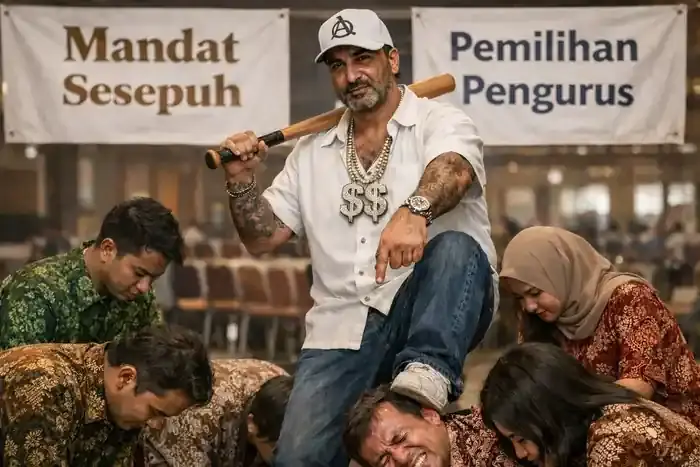
Problems arise when moral authority turns into administrative power claims. Some elders start directing community organizations. They appoint P3SRS, RT, RW administrators unilaterally. Without discussion. Without elections. Without community participation.
In this situation, social respect becomes an informal power tool. Tradition replaces legal systems.
When Tradition Replaces Civil Administration
Community administration such as P3SRS, RT, and RW is not traditional. They are part of modern civil administration. They work based on law and community participation.
Administrators should be chosen through discussion or elections, not personal appointment. When someone appoints administrators because they feel senior, wealthy, or influential, informal power is formed.
This may seem minor, but it creates miniature authoritarianism in the community.
Social Disease
Social feudalism still exists. People submit to figures seen as superior. Decisions come from strong figures. People hesitate to question. Discussion is replaced by directives. Social status does not grant administrative authority.
Power patronage works through loyalty. Influential figures appoint administrators. Administrators feel indebted. Decisions become biased. The community organization gradually becomes a small circle of power.
Environmental oligarchy occurs when community decisions are controlled by a small group with economic or social influence. The interests of the group override the interests of residents.
Pseudo-traditional authority, as explained by Max Weber, shows that modern power comes from law, not social status. RT, RW, and P3SRS follow legal-rational authority. Using tradition without legal mechanisms is a step back toward semi-feudalism.
Read other articles:
Do Elders Have the Right to Appoint Administrators?
Legally, no. Administrators must be chosen through discussion or elections. For apartment management, P3SRS is governed by national regulations:
Law No. 20 of 2011 on Apartment Buildings
Minister of PUPR Regulation No. 14 of 2021 on P3SRS
Minister of PKP Regulation No. 4 of 2025
The principle is clear: administrators are elected by members. The highest forum is the member meeting. No individual has the authority to appoint administrators. Unilateral appointments violate community governance principles.
What About RT and RW?
The principle is the same. Administrators are elected by residents. Mechanisms are regulated by local government regulations and national guidelines, such as:
Minister of Home Affairs Regulation No. 18 of 2018 on Village and Subdistrict Community Institutions
Administrative authority cannot come from personal appointment.
Consequences if This Culture Persists
Administrator legitimacy weakens. They are not elected by residents. Conflicts increase. Residents feel excluded. Accountability disappears. Administrators are loyal to the appointing figure, not the community. Organizations turn into patronage systems. Over time, community organizations can become miniature kingdoms.
Conclusion
Respecting elders is part of good culture. But when respect replaces legal mechanisms and community discussion, it becomes modern feudalism. Civil administration, even at the smallest level, is based on one principle: authority comes from residents, not social status. Appointing administrators without proper mechanisms builds informal power. History shows that power without legitimacy almost always leads to conflict.
FAQ
1. Can elders appoint P3SRS, RT, or RW administrators?
No. Administrators must be chosen through community discussion according to AD/ART and applicable mechanisms.
2. Why is community discussion important?
Discussions provide legitimacy to administrators and ensure decisions represent all residents. Indonesia is based on law, not authoritarianism.
3. What are the risks if administrators are appointed unilaterally?
Risks include resident conflict, weak transparency, loss of accountability, and potential corruption due to concentrated power.
4. What can residents do if unilateral appointments occur?
Residents can request an official discussion forum, clarify organizational issues, annul appointments, and encourage re-election according to legal mechanisms.
5. What if administrators refuse to step down?
Report to higher supervision or publicize the issue through social media.
Read other articles too:
- The Mystery of Invisible Power in Community Management
- The Phenomenon of Utilizing Shared Public Spaces
- Project Transparency in the Community
- The Role of Buzzers in the Community