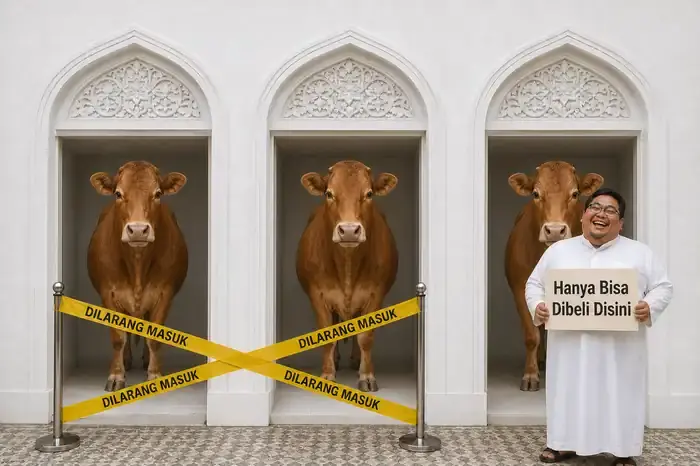


Sharia Review of the Monopoly of Qurban Animals
In Islamic teachings, the market is not merely a place to seek profit, but also a space for social justice. Therefore, Sharia pays great attention to trade practices that lead to ظلم, monopolies, restricted access, price manipulation, and conflicts of interest.
If a trading area is made tightly closed with restricted access, for example a gated residential area with 1 or more closed gate portals using access cards, where only residents are allowed to enter, this may be categorized as a closed residential area. Then, if outside traders are prohibited from entering while only certain groups or internal committees are allowed to sell, serious questions arise regarding justice, trustworthiness, and the potential for monopoly in Islam.
Islam Prohibits Monopoly and Market Restriction
In fiqh muamalah, the practice of controlling the market to unfairly restrict competition is known as ihtikar (harmful hoarding/monopoly).
The Messenger of Allah ﷺ said:
“No one practices ihtikar except a sinner.”
— Narrated by Muslim
This hadith serves as the basis that all forms of market control which harm society and obstruct fair trade mechanisms are considered reprehensible acts.
Although the classical context refers to hoarding goods, scholars explain that its essence includes:
- controlling distribution,
- restricting market access,
- creating dependency,
- and taking profit through unfair means.
The Prohibition of Preventing Traders from Entering the Market
During the time of the Messenger of Allah ﷺ, the market of Madinah was made open. There was to be no unilateral control by any particular group.
It was narrated:
“This market must not be restricted and no taxes should be imposed on it.”
— Narrated by Ibn Majah
The important meaning of this hadith is:
- the market must remain open,
- there must be no exclusive control,
- and there must be no unjust barriers against other traders.
If there is a system involving:
- closed gate portals, especially more than 1 portal
- restricted access where only residents are allowed to enter,
- outside traders being prohibited,
- while internal groups are free to trade,
then this may lead to practices of economic injustice or monopoly if it is carried out for the benefit of certain groups.
Conflict of Interest in Trust and Responsibility
In Islam, committees or managers are trustees (amin), not holders of power to take hidden profits.
Allah says:
“Indeed, Allah commands you to render trusts to whom they are due and when you judge between people to judge with justice.”
— QS. An-Nisa: 58
When the party that:
- creates the rules,
- controls access,
- determines who may trade,
- and simultaneously becomes the seller,
then a conflict of interest arises.
According to Sharia principles, such conditions are vulnerable to:
- abuse of trust,
- injustice,
- non-neutral decisions,
- and betrayal of the public interest.
Islam Teaches Honest Competition
Allah says:
“And do not consume one another’s wealth unjustly.”
— QS. Al-Baqarah: 188
This verse forms the basis for prohibiting:
- trade manipulation,
- access manipulation,
- market engineering,
- as well as taking profits through unhealthy means.
Islam does not prohibit seeking profit. However, Islam prohibits profits obtained by:
- unjustly closing opportunities for others,
- abusing one’s position,
- or creating rules for personal benefit.
The Danger of “Committees Acting as Sellers”
In modern social practice, the most vulnerable condition occurs when:
- the committee,
- distribution managers,
- payment recipients,
- rule makers,
- and sellers,
come from the same circle without open oversight.
This has the potential to cause:
1. price monopoly,
2. market conditioning,
3. forced choices,
4. loss of transparency,
5. as well as the destruction of public trust.
Meanwhile, the Messenger of Allah ﷺ said:
“The honest and trustworthy merchant will be with the prophets, the truthful, and the martyrs.”
— Narrated by Tirmidhi
This hadith shows that the nobility of trade in Islam is built upon:
- honesty,
- openness,
- trustworthiness,
- and justice.
Sharia Principle: The Market Must Be Fair and Open
Islam fundamentally encourages:
- healthy competition,
- fair access,
- open consultation,
- and separation of trust from personal interests.
Therefore, if there is a closed trading system that:
- prohibits other sellers from entering,
- locks market access,
- while certain groups take profits for themselves,
then the public has the right to question aspects of:
- justice,
- trustworthiness,
- transparency,
- and conformity with Islamic Sharia values.
Because in Islam, authority over the market is not a tool to dominate group profits, but rather a trust that must be carried out fairly before Allah SWT.
FAQ
1. Does Islam prohibit someone from becoming a seller?
No. Islam permits trade and seeking profit as long as it is conducted honestly, fairly, and without harming others.
2. What is meant by monopoly in Islam?
Monopoly in Islam refers to market or distribution control that harms society and obstructs healthy competition.
3. May a committee also act as a seller?
It is permissible if it is transparent regarding the mechanism of its formation meeting, fair, does not abuse authority, does not create rules benefiting itself, and is accompanied by detailed numerical reporting.
4. How can such dirty practices be eliminated?
Such dirty practices cannot be completely eliminated and can only be reduced. This is because not many Muslim residents yet understand Islamic Sharia Muamalah principles. The only way to reduce it is by not participating in purchasing such goods and not supporting such dirty practices.
5. What are the main principles of trade in Islam?
Honesty, openness, trustworthiness, justice, and not taking profit through false or unjust means.
Read other articles as well:
- The Unseen Emerges When Residents’ Voices Are Silenced
- Between Glue Intoxication and Residential Hallucinations
- Project Transparency in Communities
- Know Your IPL Rights and Obligations
- Magic Tricks in Community Expense Reports